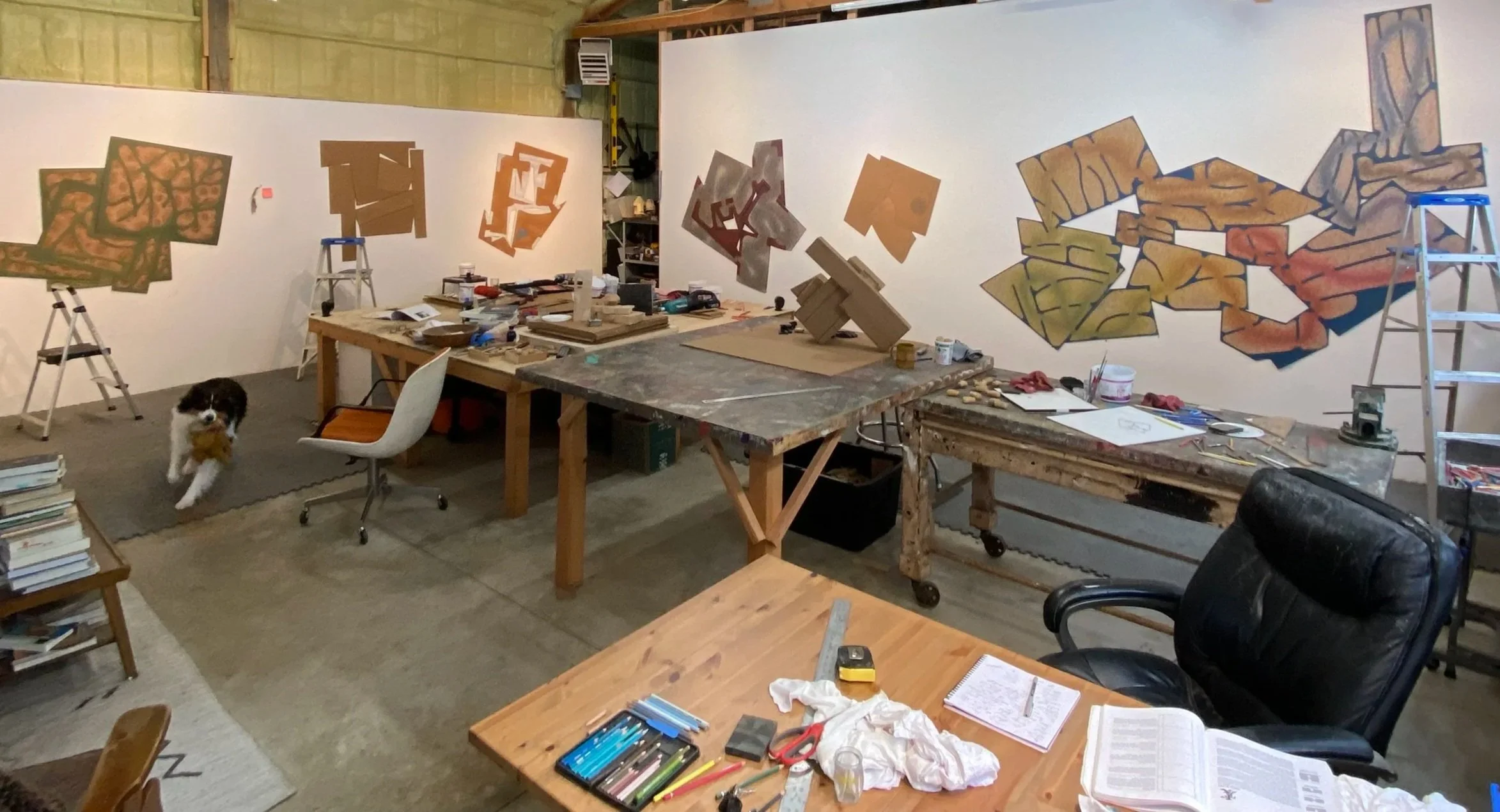
Every painting starts as drawings made directly on the bare panel. Figures, often people, animals, plants, trees, or places I know. Some I don't, or don't anymore. My daughter, my wife, friends, a cottonwood, a dog. Put down quickly and from memory. Then I carve most of it away. What remains is the pressure that's left in the surface rather than any likeness, and that absence organizes everything that comes after. The ground has taken them in. Some of them surface anyway, faint under the watercolor: a head, an arm, a foot, the corner of a house. You have to be close, and the light has to be right.
The panels are cork, which is bark milled to flour and baked back into a sheet, so the carving is done on a tree that has already been taken apart once. The rest of the surface is cut into several thousand small divots. Each one holds a shadow, and the shadows are legible from across a room. None of the depth in these paintings is illusion. It is physical, and it moves when the light in the room moves.
Watercolor goes in first and soaks. Then highly pigmented wax and oil pencil, layer over layer over layer. The color is optical rather than mixed. A zone reads red because red is distributed through it, not because red was laid on top of it. It takes a great many colors to make a new one.
A rectangle is architecture before it is a picture. It fixes you in one place and sets the view for exactly where you happen to be standing. This work is mounted to project from the wall, each shape oriented at its own angle, with the gaps left open, and it never resolves into a rectangle. The shape comes from walking a place, and from what stays.
Pieces run from four to twenty feet across. At arm's length they break into thousands of separate marks and resolve into almost nothing you could name. At fifteen feet a canopy assembles, or weather, or a ridge. Neither distance holds the painting. A view is what a rectangle gives you. Everything else you have to be there for.